Affiliate disclosure: Tradqora may earn a commission if you sign up through some links on this page. Practising on a demo costs nothing, and we’d suggest staying there until you’ve read the checklist at the end.
For many beginners, the first look at a trading chart is confusing. Prices move quickly, the terminology is unfamiliar, and online content often focuses on fast profits rather than real understanding.
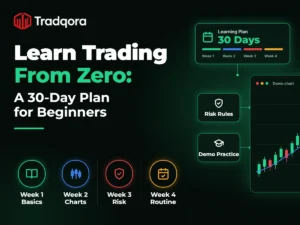
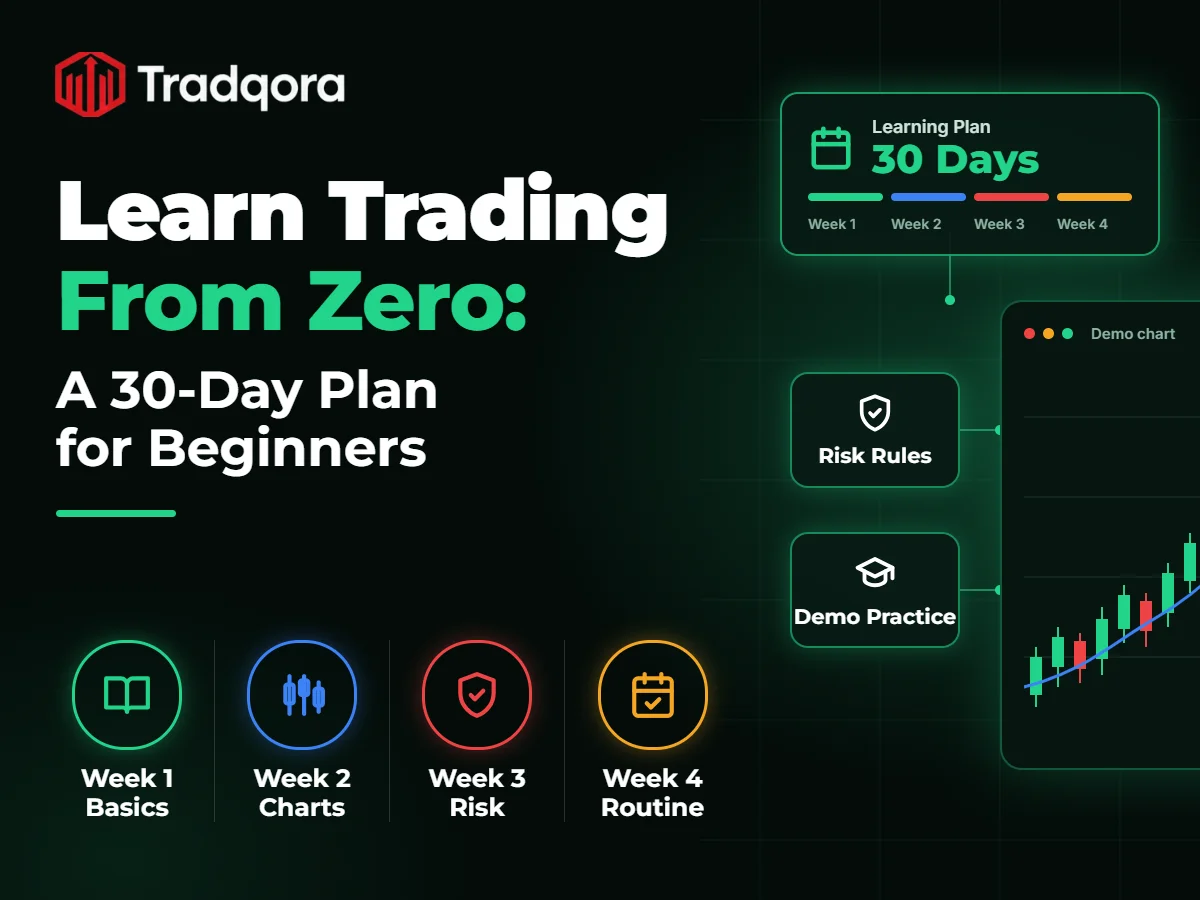
This guide offers a structured 30-day plan with one focused task each day. By the end of the month, you will understand how financial markets work, how to read a price chart, how to manage risk, and how to practice without using real money.
It is important to set realistic expectations. Thirty days is not enough to become a consistently profitable trader. A study of Brazilian day traders found that 97% of those who traded for more than 300 days lost money. This plan should therefore be treated as a foundation for further learning, not as a shortcut to results.
Before You Begin
You will need the following:
- Around 45 minutes each day.
- A notebook or spreadsheet to use as your trading journal.
- A free demo account or charting tool. If you are new to this, start by reading what a demo trading account?
- A clear rule: no real-money trades during these 30 days.
Week 1: Understand the Fundamentals
The first week focuses on building the basic knowledge and vocabulary that every later lesson depends on.
- Day 1: Learn what trading is. In simple terms, trading means buying and selling assets to benefit from price changes. Write a short definition in your own words.
- Day 2: Study the main markets: forex, stocks, commodities such as gold, and cryptocurrencies. Note the trading hours of each.
- Day 3: Learn essential trading terms such as spread, volatility, and liquidity. Some trading products also have an expiry time, so make sure you understand the terminology relevant to the market you choose.
- Day 4: Understand the difference between trading and investing. Investing usually focuses on long-term growth, while trading targets shorter price movements and generally involves higher risk.
- Day 5: Learn how leverage works. It increases potential gains, but it increases potential losses by the same proportion.
- Day 6: Learn the three basic order types: market, limit and stop orders. Open a demo account, but do not place any trades yet.
- Day 7: Review the week by testing yourself on ten key terms. Aim to answer at least eight correctly.
Week 2: Learn to Read Charts
In the second week, you will learn how to interpret price charts and identify common patterns.
- Day 8: Learn how candlestick charts work. Each candle shows the opening, closing, highest, and lowest prices of an asset during a specific period. Practice identifying these four values on a price chart to understand how prices move over time.
- Day 9: Learn to identify a trend. A series of higher highs and higher lows indicates an upward trend. Practice on three different charts.
- Day 10: Identify support and resistance levels, which are price zones where the market has repeatedly paused or reversed.
- Day 11: Add a moving average to your chart and observe how it smooths price data while reacting with a slight delay. To see how chart tools are arranged on the platform, refer to our Quotex trading platform guide.
- Day 12: Add the Relative Strength Index (RSI). Record three instances where it reached an extreme level and note what followed.
- Day 13: Find two examples where an indicator gave a false signal. This shows that no tool can predict market movements with certainty.
- Day 14: Annotate one complete chart with the trend, key levels and indicators, and save it in your journal.
Week 3: Manage Risk and Practice
The third week is the most important part of the plan. Many beginners lose money not because they cannot read charts, but because they do not manage risk properly.
- Day 15: Set a clear limit on how much you will risk on each trade, and record it in writing. Our guide to risk management in trading explains why this matters.
- Day 16: Practice calculating trade sizes based on your risk limit.
- Day 17: Set up your demo account correctly. Reset the balance to a realistic amount, since a very large virtual balance can encourage careless habits. Learn how to open and reset a Quotex demo account.
- Day 18: Prepare a short checklist to review before every trade. Then place five demo trades and record the reason for each one.
- Day 19: Monitor your emotions. After each trade, rate your level of stress or excitement on a scale of 1 to 5.
- Day 20: Understand fixed-payout trades. On some platforms, a trade either pays a fixed amount or results in the loss of the full stake. The U.S. SEC explains this clearly on its binary options page.
- Day 21: Calculate your break-even rate. If a winning trade pays 80% and a losing trade costs the full stake, you must win about 56% of trades simply to break even. At a 70% payout, the figure rises to about 59%. Our beginner trading strategy guide explains how to build rules around this.
Week 4: Build a Consistent Routine
The final week brings everything together into a routine you can continue after the plan ends.
- Day 22: Complete your journal for every demo trade so far, including the entry, reason, result and emotional state. You can use our free trading journal template.
- Day 23: Write a one-page practice plan that sets out your rules and daily limits.
- Day 24: Review your trades and identify your two most frequent mistakes.
- Day 25: Consider how real money might affect your decisions. Demo trading feels calm because nothing is at stake; live trading does not.
- Day 26: Complete a 20-question review covering Weeks 1 to 3.
- Day 27: Revisit the two topics you found most difficult.
- Day 28: Learn how to assess whether a trading platform is safe (see the section below).
- Day 29: Choose one topic to study in more depth.
- Day 30: Summarise what you have learned and what you still need to understand. Completing the plan does not mean you are ready to trade with real money; it means you have built a solid starting point.
How to Choose a Platform Safely
Before downloading any trading app or depositing funds, complete the following checks:
- Confirm it is authorised in your country. Search for the platform on your national regulator’s website and review its warning list. In Pakistan, this is the SECP; in India, refer to SEBI and the RBI Alert List.
- Verify the official website. Imitation websites are common. Learn how to check you are on the official website.
- Read the terms and conditions. Review withdrawal limits, verification requirements, fees and any bonus conditions. Our Quotex review covers these points in detail.
- Begin with the demo account only. Understand how charts, orders and payouts work before considering anything further.
- Test withdrawals with a small amount. If you decide to fund an account, start with a small deposit and confirm that it can be withdrawn without difficulty.
- Use payment methods in your own name. Avoid transferring money to personal accounts or unknown agents.
- Protect your personal information. Share identity documents only through the official website or app, never through messaging apps.
- Disregard guaranteed-profit claims. “Signal” groups on WhatsApp or Telegram and profit screenshots are common warning signs. Read more on how to spot trading scams.
- Only risk money you can afford to lose. Never trade with borrowed money or essential savings.
What Comes After Day 30?
Continue practising on a demo account, maintain your journal and review it every week. Focus on improving one skill at a time. Meaningful progress in trading is built over months and years of disciplined practice.
Frequently Asked Questions
Q: Can I learn trading in 30 days?
You can learn the fundamentals in 30 days, including key terms, chart reading, risk management and demo practice. Becoming consistently profitable takes considerably longer, and most retail traders do not achieve it.
Q: Can I learn trading without real money?
Yes. A demo account allows you to practice with virtual funds. However, demo results do not reflect how you may perform when real money and real emotions are involved.
Q: How much money do I need to start?
None is required to start learning. Use a demo account for at least the full 30 days, and only ever trade with money you can afford to lose entirely.